


| Intro |
| Load Index |
| Speed Index |
| Width |
| Aspect Ratio |
| Construction |
| Rim Diameter |
| ENLITEN Technology |
| OE Sidewall Marking |
| RFT |
| B-Seal |
| B-Silent |
| Ologic |
| HL Tyres |
| Energy Label |
| EU Taxonomy |
Tyre markings explained
Have you ever wondered what the markings on the sidewall of your tyre mean? Your tyre’s sidewall markings are a tyre specification guide containing important information about size, load, and much more. This indicates the nominated tyre size for your vehicle from the manufacturer. Be careful if changing away from the nominated tyre size, as this could make your vehicle un-roadworthy. Learn how to read tyre codes below.
Load Index
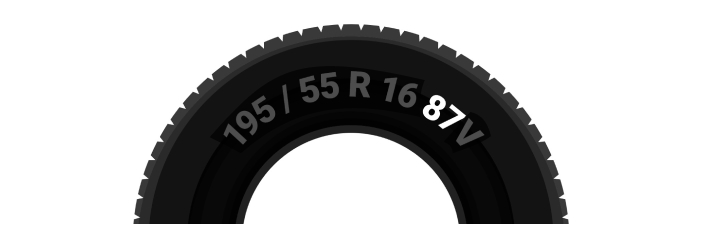
After the rim diameter, we find the load rating. This tells you the maximum capacity of a passenger car tyre when it is inflated to its maximum safe pressure. The figure (in this example, “87”) refers to the index rather than the weight. As such, you will need to consult a load index table (below) which determines the load in kg for each rating. For a load index of “87”, the maximum load weight is 545kg/tyre.
| Li | Kg | Li | Kg | Li | Kg | Li | Kg | Li | Kg | Li | Kg |
|---|---|---|---|---|---|---|---|---|---|---|---|
| Percentage Of Load Capacity (%) versus Speed | ||||
|---|---|---|---|---|
|
Speed Capability of the vehicle (km/h) |
||||
| Speed Symbol | ||||
| H | V | W | Y | |
| % | % | % | % | |
Speed Index
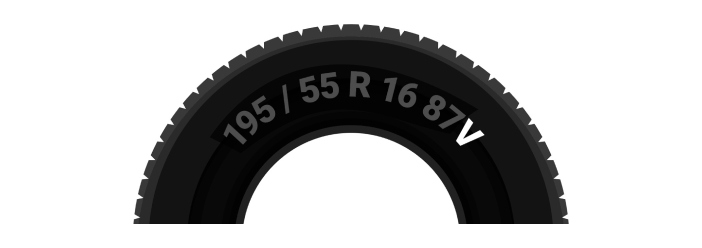
The final tyre marking in this string represents the speed rating. As you might have guessed, this denotes the maximum speed a tyre can sustain when it is correctly inflated and under load. As with the load index, this letter references a look-up table which indicates the maximum permissible speed of a tyre. In this example, “V” means the vehicle has a maximum speed of 240 km/h under the maximum load.
| SS | KM/H | SS | KM/H | SS | KM/H | SS | KM/H | SS | KM/H |
|---|---|---|---|---|---|---|---|---|---|
Width
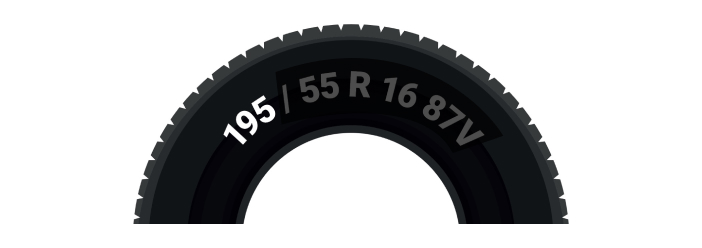
The section width of your tyre in millimetres, from the inner sidewall to the outer sidewall. Example: 195mm
Aspect Ratio
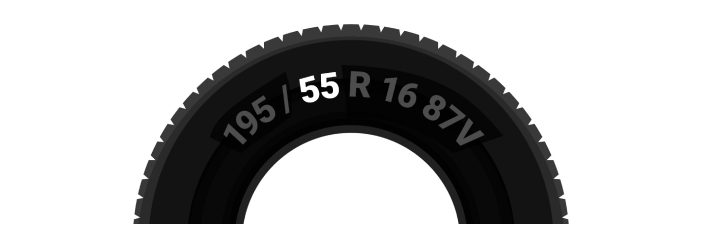
The following two numbers (“55”) represent the aspect ratio - or measurement of the sidewall height (in mm). Essentially, this is the ratio of the tyre's cross-section to its width. So, in the above example, a tyre that has an aspect ratio of 55 would have a height equal to 55 per cent of its width.
Construction
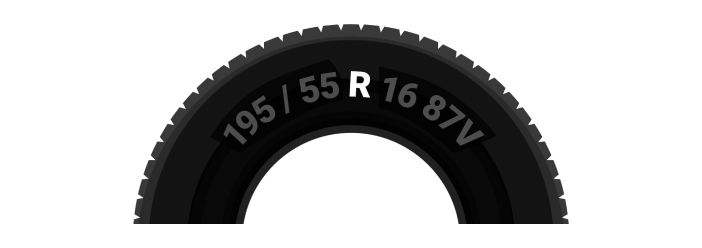
Next up is a letter. This tells you how a tyre is constructed. In this example, the “R” means that the tyre has radial construction. This is where the internal ply cords extend across the casing from bead to bead, in a radial direction. Less common tyre constructions include diagonal or bias ply, represented by the letter “D”.
Rim Diameter
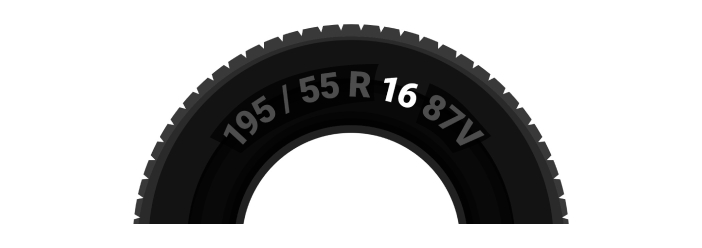
The next number represents the diameter code. Unlike the width, this is shown in inches. This is particularly important because it represents the diameter of the wheel rim. In the above example, the number “16” means that the tyre should be matched to a rim wheel of 16 inches.
ENLITEN Technology
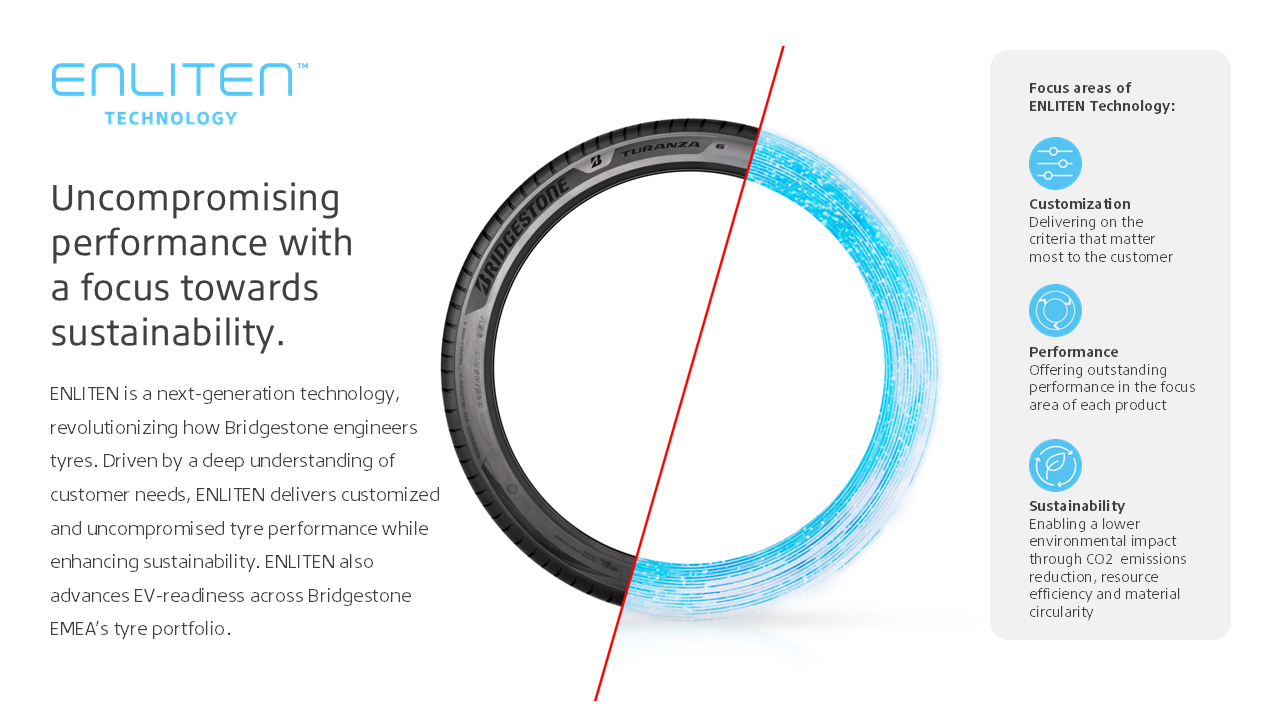
ENLITEN is a combination of cutting-edge technologies
Providing
- Improved sustainability characteristics.
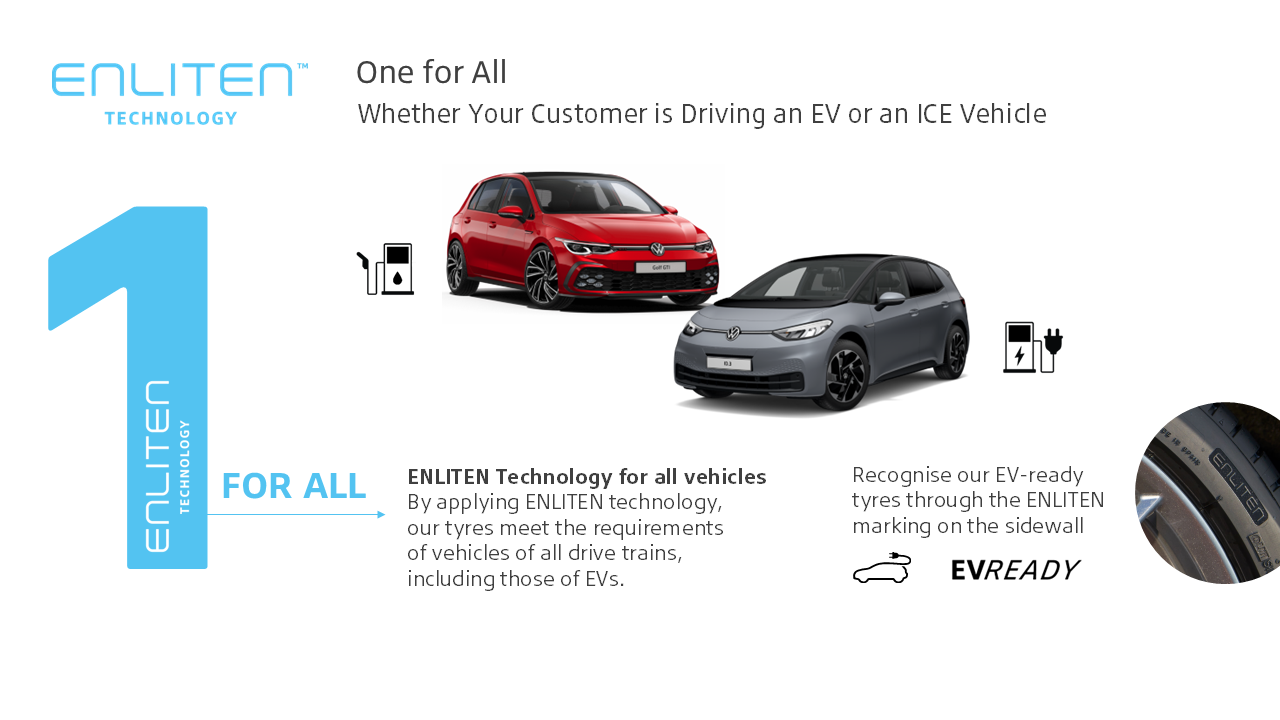
- EV-readiness
Without compromising on
- Safety
- Outstanding tyre performance
Example:
ENLITEN brings a combination of cutting-edge technologies to Turanza 6:
Providing
- Significant longevity improvements
+ 22% mileage vs predecessor1 - Reduced rolling resistance
-4% rolling resistance vs predecessor1 - EV-readiness
Without compromising on
- Best-in-class wet performance2
- Best cornering aquaplaning
- Best wet cornering
-
Outstanding wet braking and
straight-line aquaplaning - Best-in-class dry braking2
1) Based on internal benchmark Turanza 6 vs Turanza T005 (ref. size 205/55 R16)
2) Tests carried out by TÜV SÜD on the request of Bridgestone in June 2022 at the facilities ATP Papenburg (Germany) & Bridgestone EUPG (Italy) for wet tests and dry braking tests with BMW 520i & BMW 530d, on tyre size 245/45 R18 100Y XL. Turanza 6 compared to the performances of main competitors in the same segment: CONTINENTAL Premium Contact 6, MICHELIN Primacy 4+, PIRELLI Cinturato P7 (P7C2) Report No. [713263409]. AQUAPLANING LATERAL, rating: BRIDGESTONE Turanza 6 (100%) CONTINENTAL Premium Contact 6 (92%), MICHELIN Primacy 4+ (90.2%), PIRELLI Cinturato P7 (P7C2) (96.9%). AQUAPLANING STRAIGHT-LINE, rating: CONTINENTAL Premium Contact 6 (100.2%), BRIDGESTONE Turanza 6 (100%), PIRELLI Cinturato P7 (P7C2) (98.9%), MICHELIN Primacy 4+ (98.5%),. LATERAL WET GRIP, rating: BRIDGESTONE TURANZA 6 (100%) CONTINENTAL Premium Contact 6 (97%), MICHELIN Primacy 4+ (95.1%), PIRELLI Cinturato P7 (P7C2) (93.3%). WET BRAKING (Ø CALC. Stopping Distance [m] 80-20 km/h) rating: CONTINENTAL Premium Contact 6 (33), BRIDGESTONE Turanza 6 (33,7), PIRELLI Cinturato P7 (P7C2) (34.4), MICHELIN Primacy 4+ (36). DRY BRAKING, (Ø CALC. Stopping distance [m] from 100 to 0 km/h → Mean deceleration [m/s²]) Rating: BRIDGESTONE Turanza 6 (33,1) CONTINENTAL Premium Contact 6 (33,2), MICHELIN Primacy 4+ (33,5), PIRELLI Cinturato P7 (P7C2) (34,3).
OE sidewall marking
| CAR MANUFACTURER | MARKING | ADDITIONAL INFO |
|---|---|---|
 |
A2A, A4A, A5A, AM2, AM8, AM9, AMR, A5 |
|
 |
AO, AO1, RO1, RO2 AO AOE |
RO = Audi RS Shared marking with VW; EV's and other cars Audi Original Extended = Run Flat Technology (AOE) |
 |
  |
Run Flat Technology (RFT) |
 |
GOE |
Hyundai Genesis GV70 gets its own marking “GOE” |
 |
L | |
 |
MGT |
Maserati Levante gets its own marking „MGT“. |
 |
MO, MO1 MOE MO-S, MOE-S MO-V |
Mercedes Original Extended = Run Flat Technology (MOE) B- Silent-Technology or B-Silent- + Extended-Technology Vans |
 |
N-0, N-1, N-3, N-4 |
The N indentifier can be found in the vehicle registration document |
 |
RS |
Renault Mégane RS Trophy gets ist own marking „RS“. |
 |
AR | |
 |
AO |
Shared marking with Audi; EV's and other cars |

Bridgestone is the market leader in Run-Flat tyres.
We first introduced this technology as an OE fitment in the 1980s.

SAFETY
Keep control of the vehicle
even after a puncture
or damage

CONVENIENCE
No need to stop to change
tyres if a puncture or
damage happens

CONFORT
Latest generation
Run-Flat delivers a
comparable driving comfort
as conventional tyres
HOW IT WORKS:
CONVENTIONAL TYRE
RUN-FLAT TYRE
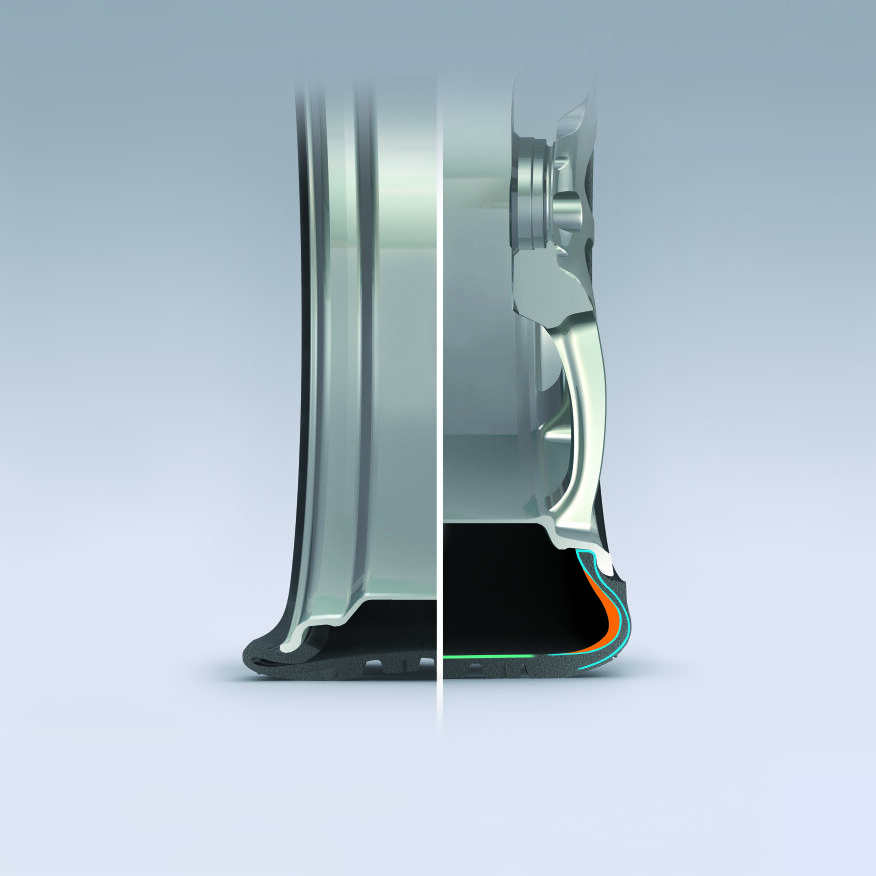
Our B-SEAL technology contains a sealant material in the tyre that
guarantees temporary air retention in case of a puncture in the tread area.
INCREASED PROTECTION
B-SEAL isolates the damage
made by an object (up to 5mm)

ADAPTABLE TECHNOLOGY
B-SILENT retrofit is available
for any vehicle
MAINTAIN PERFORMANCE
The same great tyre
performance drivers expect
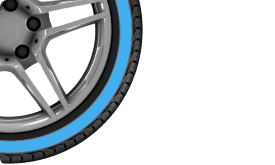
Tyre contains B-SEAL sealant
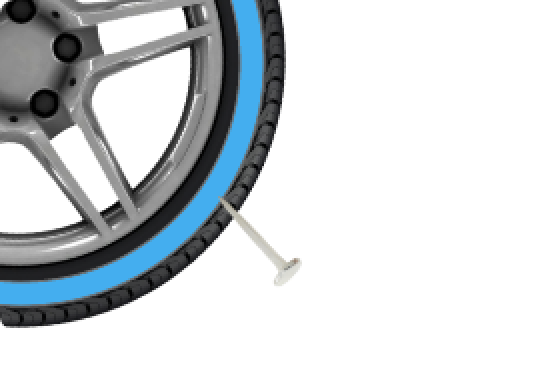
When a puncture occurs, B-SEAL
instantly prevents air leakage
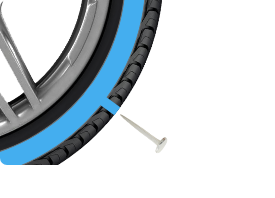
After removing the object,
B-SEAL closes the gap
Our B-SILENT technology is engineered to reduce in-vehicle noise.
A special sponge absorbs disruptive sounds that come from tyre cavities.

REDUCED NOISE
Technology decreases the
sound inside a vehicle
MAINTAIN PERFORMANCE
The same great tyre
performance drivers expect
ADAPTABLE TECHNOLOGY
B-SILENT retrofit is available
for any vehicle


OLOGIC is a technology that helps improve fuel efficiency.
It also results in reduced CO2 emissions.
REDUCE FUEL CONSUMPTION
Less air resistance and tread deformation
with higher inflation pressure resulting in
reduced rolling resistance
SAFETY
Improved dry and wet performance
thanks to unique construction and
pattern design

Narrower width
Improves:
Weights
Air Resistance
Aquaplaning
Pass-by noise

Larger diameter
Improves:
Rolling Resistance

Higher inflation pressure
Improves:
Rolling Resistance
Aquaplaning

Construction
Optimises:
Stiffness
Pattern
Improves:
Dry/wet Grip
Dry/wet Handing
Wear

Tread Compound
Improves:
Dry/wet Grip
Wear
HL Tyres
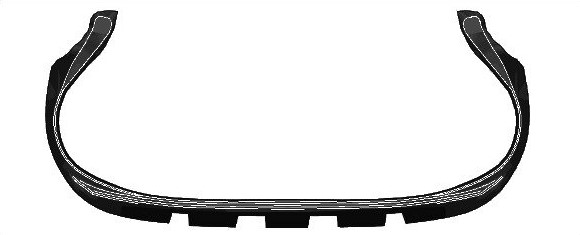
The HL capacity category was developed to indicate tyres that are able to carry the higher
load and support
the more demanding fatigue cycle of powerful electric and hybrid vehicles.
In order to carry the extra load with the same tyre size andat the same pressure as extra load tyres, special improvements have been incorporated where the additional load causes more stress.
These improvements include strengthening the bead and shoulder areas of the tyre, using new sidewall and tread compound designs, and applying an optimised geometric tyre shape.
EXAMPLE:
THE DIFFERENCES BETWEEN TYRES WITH A STANDARD, EXTRA AND HIGH LOAD
| ... | Size | Load Index | Total weight allowed per vehicle (kg) | Additional Info |
|---|---|---|---|---|
| Standard Load | 255/40R20 | 97 |
730 kg x 4 tyres = 2920 kg
Load index: +4 |
2.5 |
| Extra Load (XL) | 255/40R20 | 101 |
825 kg x 4 tyres = 3300 kg
Load index: +3 |
2.9 |
| High Load (HL) | 255/40R20 | 104 |
900 kg x 4 tyres = 3600 kg . |
2.9 |
Load index: +7
Weight: +680 kg
Energy Label
EU Taxonomy
The EU Taxonomy is a system developed by the EU to help determine economic activities which are good for the environment i.e. more sustainable. It’s aimed at helping companies, financial institutions and investors identify sustainable activities to enable ‘green’ investment decisions.